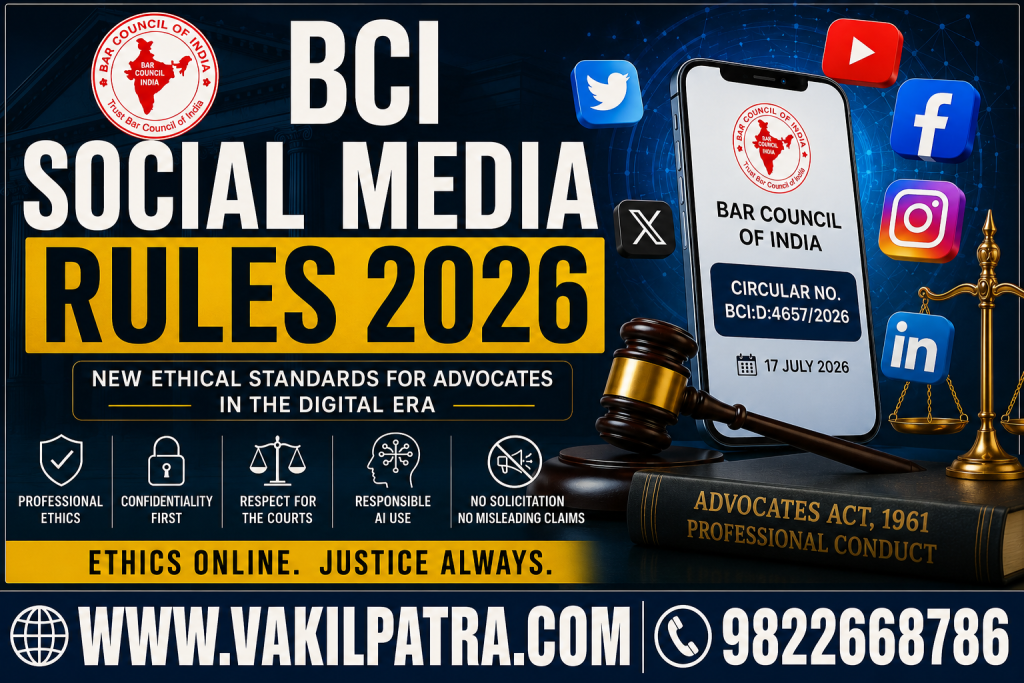
BCI Social Media Rules 2026
The Bar Council of India (BCI) has issued one of the most comprehensive professional conduct circulars in recent years, fundamentally changing how advocates, law students, interns, law firms, Bar Associations, and legal influencers may use social media.

The Circular dated 17 July 2026 seeks to preserve the dignity of the legal profession while preventing misuse of digital platforms, AI-generated content, sensationalism, and unethical online solicitation.
If you regularly upload legal videos on YouTube, Instagram, Facebook, LinkedIn, or X (Twitter), this circular directly affects you.
The digital revolution has transformed every profession, and the legal fraternity is no exception. Over the past few years, thousands of advocates, law students, legal educators, and law firms have embraced platforms such as YouTube, Instagram, Facebook, LinkedIn, and X (formerly Twitter) to educate the public, discuss landmark judgments, and build professional visibility. Legal awareness campaigns have become more accessible than ever before, helping citizens understand their constitutional rights, consumer protection laws, criminal procedures, cyber laws, and other important legal issues. While this digital transformation has democratized access to legal knowledge, it has also introduced serious ethical concerns that threaten the dignity of the legal profession and the administration of justice.
Recognizing these emerging challenges, the Bar Council of India (BCI), the apex statutory body regulating advocates in India, has issued one of the most comprehensive professional ethics circulars in recent history. The BCI Social Media Rules 2026 are intended to regulate how advocates, law students, interns, Bar Associations, law firms, and legal content creators conduct themselves on digital platforms. Rather than prohibiting the use of social media altogether, the circular establishes a framework that balances freedom of expression with professional responsibility, ensuring that legal education remains ethical while preventing commercialization of legal practice.
The Circular No. BCI:D:4657/2026, dated 17 July 2026, reflects the Bar Council’s growing concern regarding the increasing misuse of social media by individuals associated with the legal profession. It notes a disturbing trend where court proceedings are selectively recorded, judicial observations are presented out of context, client matters are discussed publicly, and artificial intelligence is being used to create fabricated legal content capable of misleading the public. These developments, according to the Council, have the potential to erode public confidence in the judiciary and compromise the ethical foundations upon which the legal profession has been built.
Unlike previous advisories that primarily focused on advocate advertising or professional etiquette, this circular addresses an entirely new digital ecosystem. Today, a single viral reel can reach millions of viewers within hours. Unfortunately, this unprecedented reach has encouraged some content creators to prioritize sensational headlines, dramatic courtroom narratives, and exaggerated legal claims over factual accuracy. The result has been a surge in misinformation where complex legal principles are oversimplified, judicial decisions are misrepresented, and viewers are often left with unrealistic expectations regarding legal remedies. The BCI Social Media Rules 2026 seek to correct this growing imbalance by reaffirming that professional ethics apply equally in the online world as they do inside the courtroom.
Another important factor behind the issuance of this circular is the rapid advancement of artificial intelligence technologies. Deepfake videos, cloned voices, AI-generated judicial orders, fabricated case laws, and manipulated court visuals have become increasingly sophisticated, making it difficult for ordinary citizens to distinguish authentic legal information from digitally altered content. The Bar Council has therefore expressed serious concern that such technologies may be exploited to fabricate court proceedings, misrepresent judicial observations, or create misleading legal narratives capable of damaging the credibility of judges, advocates, litigants, and the justice delivery system itself. The circular emphasizes that technological innovation cannot become a shield for unethical professional conduct.
Importantly, the circular does not attempt to discourage genuine legal education. In fact, the Bar Council expressly acknowledges that advocates have a valuable role in promoting constitutional awareness, legal literacy, consumer protection, cyber safety, women’s rights, child protection, environmental law, and other areas of public importance. Educational discussions on judgments, academic debates, seminars, webinars, and legal awareness campaigns continue to be encouraged, provided they remain accurate, objective, and free from solicitation or sensationalism. This distinction demonstrates that the Council is not opposed to digital engagement itself but is instead concerned with preserving the dignity and credibility of the legal profession while adapting to changing technological realities.
The timing of these reforms is particularly significant. Social media has increasingly become a primary source of legal information for the general public. Many individuals now seek legal advice through short-form videos, podcasts, reels, and online live sessions before consulting an advocate. While this has expanded access to legal knowledge, it has also created opportunities for misinformation, indirect advertising, and commercial exploitation. Some creators have begun presenting guaranteed legal outcomes, simplified bail formulas, or exaggerated claims regarding divorce, property disputes, taxation, and criminal litigation. Such practices not only mislead viewers but also undermine the dignity of advocacy as a noble profession governed by statutory ethics rather than market competition. The BCI Social Media Rules 2026 therefore seek to restore public trust by clearly distinguishing responsible legal education from unethical self-promotion.
From a broader constitutional perspective, the circular also reinforces the principle that the legal profession occupies a unique position within the justice delivery system. Advocates are not merely service providers or content creators competing for online popularity; they are officers of the court entrusted with responsibilities that extend beyond individual client representation. Every public statement made by an advocate has the potential to influence public perception regarding the judiciary, pending litigation, and the rule of law. Consequently, professional conduct in the digital sphere must reflect the same standards of integrity, fairness, confidentiality, and respect that are expected inside a courtroom. This underlying philosophy forms the foundation of the BCI Social Media Rules 2026, making the circular one of the most significant regulatory developments for the Indian legal profession in the digital era.
Read
How the BCI Social Media Rules 2026 Will Transform Digital Legal Practice in India
The BCI Social Media Rules 2026 represent much more than another regulatory advisory issued by the Bar Council of India. They establish a comprehensive code of digital ethics that extends traditional professional conduct into the online ecosystem. Every advocate, law student, intern, Bar Association, legal educator, law firm and legal content creator is expected to understand that professional obligations do not end when they leave the courtroom. Instead, the same standards of dignity, confidentiality, fairness and responsibility continue to apply on YouTube channels, Instagram pages, Facebook posts, LinkedIn articles, podcasts, blogs and every other digital platform used for professional communication. The Circular clearly conveys that technology may change the mode of communication, but it cannot dilute the ethical obligations imposed under the Advocates Act, 1961 and the Bar Council of India Rules.
One of the strongest messages conveyed by the Circular is that advocates should never compromise the dignity of courts for the sake of digital popularity. In recent years, social media has witnessed an increasing number of videos portraying court proceedings through dramatic narration, selective editing and sensational commentary designed to maximise views and engagement. Short clips extracted from lengthy hearings frequently omit the legal context behind judicial observations, leading viewers to misunderstand the issues involved in a case. Such selective presentation not only misinforms the public but also creates an inaccurate perception about judges, advocates and litigants. The Bar Council has therefore emphasized that courtroom proceedings cannot be converted into entertainment content merely because technology makes recording and editing easier. Court premises remain institutions of justice, not locations for influencer marketing.
The Circular further reiterates that every advocate owes a continuing duty of respect towards the judiciary irrespective of whether arguments are being advanced inside the courtroom or opinions are being expressed on digital platforms. Critical legal analysis of judgments remains permissible, as academic debate has always contributed to the development of law. However, personal attacks against judges, ridicule of judicial institutions, misleading commentary intended to provoke controversy, or edited videos capable of lowering public confidence in the administration of justice fall outside the scope of legitimate professional discourse. According to the Bar Council, criticism must remain fair, informed and respectful, ensuring that constitutional institutions retain the confidence of the public they serve. This principle lies at the heart of the BCI Social Media Rules 2026, reinforcing that freedom of speech carries corresponding professional responsibilities for advocates.
Another significant feature of the Circular is its detailed discussion regarding professional advertising and indirect solicitation. Indian advocates have historically been prohibited from advertising legal services in the same manner as commercial businesses. With the rise of digital marketing, however, new methods of indirect promotion have emerged through sponsored posts, influencer collaborations, paid interviews, promotional reels, algorithm-driven advertisements and exaggerated claims regarding legal success. The Bar Council has expressed serious concern that many legal creators now package legal advice in the form of attention-grabbing headlines promising guaranteed bail, assured divorce decrees, instant consumer relief or certain victory in litigation. Such representations create unrealistic expectations among litigants while reducing the legal profession to a commercial enterprise competing for online attention rather than upholding the administration of justice. The BCI Social Media Rules 2026 make it abundantly clear that advocates cannot use digital platforms to achieve indirectly what professional ethics prohibit directly.
Perhaps the most modern aspect of the Circular concerns the regulation of Artificial Intelligence and synthetic media. Over the last two years, AI tools have become capable of producing highly convincing photographs, voice recordings, videos and written documents that closely resemble genuine legal material. This technological development has created unprecedented risks for the justice system. Fabricated judgments, AI-generated judicial observations, cloned voices of advocates or judges, manipulated courtroom visuals and deepfake videos possess enormous potential to mislead the public and damage institutional credibility. Recognising these dangers, the Bar Council has categorically warned against creating, circulating or relying upon fabricated legal content generated through artificial intelligence or similar technologies. The Circular stresses that no advocate should publish or distribute material capable of falsely representing court proceedings, judicial decisions or professional communications merely to increase social media engagement.
The issue of confidentiality receives equal emphasis throughout the Circular. Confidentiality has always formed one of the foundational pillars of the advocate-client relationship. Clients disclose highly sensitive information to their legal representatives with the legitimate expectation that such information will remain protected unless disclosure becomes legally necessary. In the era of social media, however, even seemingly harmless photographs or videos recorded inside chambers may unintentionally reveal confidential files, pleadings, witness statements, legal opinions or client identities. Similarly, discussions regarding ongoing litigation, screenshots of legal documents, recordings of client conferences or images captured during court visits can inadvertently compromise privileged communications. The Bar Council therefore reminds advocates that confidentiality extends beyond formal legal advice and applies equally to every form of digital communication, whether public or private. Protecting client trust remains a professional obligation that cannot be sacrificed for online popularity or content creation.
The Circular also places significant responsibility upon law students and interns, recognising that professional ethics begin long before formal enrolment as an advocate. Internship culture has increasingly encouraged students to document every aspect of their legal training through photographs, daily vlogs and social media updates. While enthusiasm for learning is commendable, unrestricted publication of court visits, chamber discussions, client files or internship experiences may violate confidentiality and professional decorum. Consequently, educational institutions are advised to obtain undertakings from students affirming that they will neither record nor publish sensitive information acquired during internships or court visits. The objective is not to discourage practical legal education but to ensure that future advocates internalise ethical responsibilities from the earliest stage of their professional development. This forward-looking approach demonstrates that the BCI Social Media Rules 2026 are intended not merely as punitive measures but as a long-term framework for strengthening professional culture within the Indian legal system.
Another noteworthy aspect of the Circular is its recognition that social media itself is not the problem. On the contrary, the Bar Council specifically encourages advocates to participate in constitutional education, legal literacy programmes, consumer awareness campaigns, cyber law education, women’s rights initiatives, environmental awareness and other public interest activities. Educational discussions on judgments, statutory amendments and legal developments remain valuable contributions to society when presented accurately and objectively. What the Circular discourages is the transformation of legal education into entertainment or commercial promotion. The distinction is both subtle and significant. An advocate explaining the principles of anticipatory bail based on statutory provisions performs an important educational function. Conversely, an advocate promising guaranteed bail within a fixed period or presenting hypothetical outcomes as legal certainty crosses the boundary into unethical solicitation. Understanding this distinction will be crucial for every legal professional seeking to build a responsible digital presence under the BCI Social Media Rules 2026.
Legal Consequences of Violating the BCI Social Media Rules 2026: Why Every Advocate Must Exercise Digital Responsibility
As social media increasingly influences public opinion, the legal profession finds itself under greater public scrutiny than ever before. Every post, video, article, podcast, livestream or comment published by an advocate has the potential to reach thousands, and sometimes millions, of viewers within minutes. While this digital visibility offers unprecedented opportunities for legal education, it also increases the risk of ethical violations capable of damaging both individual reputations and public confidence in the justice system. Recognising this reality, the Bar Council of India has made it abundantly clear that professional misconduct committed on digital platforms will not be treated differently from misconduct committed inside court premises. The BCI Social Media Rules 2026 therefore reinforce that professional ethics accompany an advocate into every online interaction, irrespective of the platform used.
The Circular reminds advocates that enrolment under the Advocates Act, 1961 is not merely a licence to practise law but also an acceptance of continuing ethical responsibilities. Every advocate functions as an officer of the Court and forms an integral part of the administration of justice. Consequently, conduct that lowers the dignity of courts, compromises client confidentiality, misleads the public or amounts to indirect solicitation may invite disciplinary scrutiny under the statutory framework governing the legal profession. The Bar Council has emphasised that the objective of these measures is not punitive but corrective, seeking to preserve public trust in advocates while ensuring that technological advancements do not weaken long-established principles of professional conduct.
The Circular outlines several possible consequences where an advocate engages in unethical digital conduct. Depending upon the gravity of the violation, disciplinary proceedings may be initiated under the Advocates Act, 1961 through the appropriate State Bar Council. Serious misconduct may also be reported to the concerned Court or Registry where court proceedings, live-streamed hearings or judicial processes have been improperly recorded or misrepresented. Where offending material violates applicable information technology laws, court rules or intermediary guidelines, the Bar Council also contemplates communication with relevant digital platforms for removal of unlawful content. In appropriate cases, advocates may additionally be directed to delete, correct, clarify or publicly withdraw misleading content where such action is legally permissible. These measures demonstrate that professional accountability now extends well beyond conventional courtroom behaviour into the digital environment.
An important feature of the Circular is its insistence that disciplinary action must continue to respect principles of natural justice. The Bar Council expressly clarifies that the Circular itself does not create new statutory offences or automatic grounds for punishment. Instead, complaints must still be examined according to the Advocates Act, applicable Bar Council Rules and established disciplinary procedures. Advocates remain entitled to notice, an opportunity to explain their conduct and consideration of relevant evidence before any adverse decision is taken. This clarification is particularly significant because it reassures the legal fraternity that the Circular operates as an ethical framework rather than an arbitrary mechanism for penalising professional expression. The emphasis remains on fairness, proportionality and due process while addressing genuine instances of digital misconduct.
The Circular also recognises that maintaining ethical standards cannot become the exclusive responsibility of individual advocates. Bar Associations, State Bar Councils, law firms and Centres of Legal Education are expected to play an active institutional role in promoting responsible digital behaviour. They are encouraged to establish internal mechanisms capable of receiving complaints, counselling first-time violators, preserving relevant digital evidence and referring serious cases to competent authorities wherever necessary. Educational initiatives, awareness campaigns and professional guidance are preferred over punitive measures in cases involving inadvertent mistakes, particularly among young advocates and law students. At the same time, repeated or deliberate violations involving misinformation, impersonation, confidentiality breaches or fabricated legal content may warrant stronger regulatory intervention. This collaborative approach reflects the Bar Council’s belief that professional ethics must be cultivated through institutional culture rather than disciplinary enforcement alone.
The Circular deserves particular attention from law firms and legal offices that increasingly rely upon digital marketing teams, social media managers and external content creators. Many firms now employ professionals who possess extensive expertise in branding and online engagement but limited understanding of legal ethics. The Bar Council makes it clear that professional responsibility cannot be outsourced. Advocates remain accountable for content published on behalf of their firms, irrespective of whether that content is created internally or by third-party agencies. Consequently, every law office should develop comprehensive editorial policies governing legal publications, approval mechanisms for digital campaigns and internal review procedures capable of ensuring compliance with professional obligations before content is made public. Ethical supervision has become as essential as legal accuracy in modern digital practice.
The Circular likewise carries profound implications for advocates who have established themselves as legal influencers across various digital platforms. Over recent years, numerous lawyers have successfully used YouTube channels, Instagram pages, podcasts and educational blogs to simplify legal concepts for the public. The Bar Council expressly acknowledges the importance of such public legal education and does not discourage responsible knowledge sharing. However, popularity cannot become a substitute for professional ethics. An advocate with millions of followers remains bound by the same duties of dignity, confidentiality and fairness as a newly enrolled practitioner. Success on social media therefore increases professional responsibility rather than diminishing it. The BCI Social Media Rules 2026 reinforce that influence should be exercised to improve legal awareness rather than to promote sensationalism, cultivate unrealistic expectations or commercialise the administration of justice.
From a constitutional perspective, the Circular attempts to strike a careful balance between freedom of speech guaranteed under Article 19(1)(a) of the Constitution and the reasonable professional restrictions that accompany enrolment as an advocate. Every citizen possesses the right to express opinions, including opinions regarding judicial decisions and legal developments. However, advocates voluntarily enter a regulated profession governed by statutory standards intended to protect both litigants and the justice delivery system. The Bar Council therefore distinguishes between legitimate academic criticism and conduct that undermines confidence in courts or constitutes professional misconduct. This distinction is consistent with long-standing judicial recognition that advocacy is not merely a commercial occupation but a public profession carrying corresponding obligations toward the rule of law.
Ultimately, the Circular reflects a broader transformation taking place across the global legal profession. Artificial intelligence, digital publishing, algorithm-driven content distribution and online legal education are reshaping the manner in which legal information reaches society. These innovations undoubtedly offer immense opportunities for improving public access to justice. Nevertheless, technology cannot replace integrity, honesty or professional judgment. The BCI Social Media Rules 2026 serve as a timely reminder that the credibility of the legal profession has always depended upon public confidence, and preserving that confidence requires advocates to exercise restraint, accuracy and ethical responsibility regardless of whether communication occurs inside a courtroom or before a smartphone camera.
The Road Ahead: Why the BCI Social Media Rules 2026 Are a Turning Point for the Indian Legal Profession
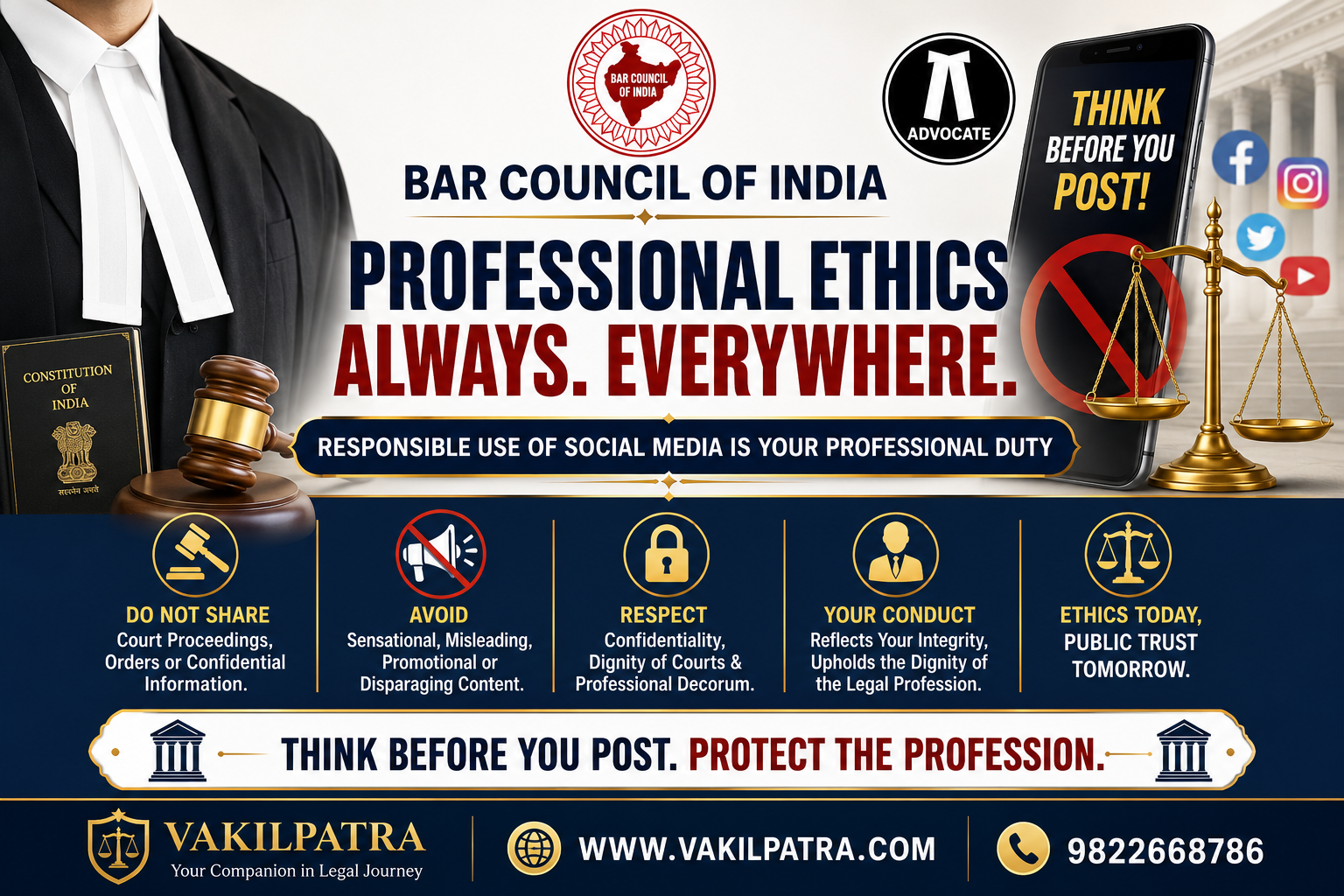
The legal profession has always evolved alongside society. From handwritten briefs to electronic filing, from physical libraries to digital legal databases, every technological advancement has reshaped the practice of law without altering its fundamental ethical values. Social media and artificial intelligence represent the next phase of this transformation. The challenge before the legal fraternity is not whether technology should be adopted, but how it should be used responsibly. The Bar Council of India has attempted to answer this question through its comprehensive Circular by reminding advocates that innovation and ethics must progress together. The legal profession enjoys a unique position in a constitutional democracy because advocates do not merely represent private interests—they actively participate in the administration of justice. Therefore, preserving public confidence in advocates is as important as preserving public confidence in courts themselves.
Viewed in this broader context, the Circular should not be interpreted as an attempt to restrict freedom of expression or discourage advocates from participating in digital discourse. Instead, it establishes a clear distinction between responsible legal education and unethical digital conduct. The Bar Council recognises that social media has become one of the most effective tools for spreading legal awareness among ordinary citizens. Millions of people now learn about consumer rights, criminal law, cyber fraud, constitutional remedies, family law, taxation and labour law through digital platforms. Advocates who create educational content contribute significantly to public legal literacy by simplifying complex statutes and judicial precedents for non-lawyers. Such efforts strengthen access to justice and promote constitutional values. However, when legal education transforms into sensational entertainment, misleading advertisements or commercial solicitation, the credibility of both the advocate and the profession begins to suffer.
The rapid growth of artificial intelligence further reinforces the importance of the Circular. AI tools are becoming increasingly capable of generating convincing legal documents, drafting petitions, summarising judgments, translating legal texts and assisting legal research. These technologies undoubtedly possess enormous potential to improve efficiency within the legal profession. At the same time, they also create unprecedented risks when used irresponsibly. Fabricated judgments, manipulated evidence, deepfake videos, cloned judicial voices and synthetic courtroom recordings can seriously undermine public confidence in legal institutions. The Circular therefore sends an important message that technology must remain a tool for improving justice rather than distorting it. Professional judgment, ethical responsibility and legal integrity cannot be delegated to artificial intelligence irrespective of how sophisticated digital tools become.
Also Read Human Right
For young advocates entering the profession, the Circular offers valuable guidance regarding the development of a sustainable professional reputation. In today’s competitive legal environment, digital visibility often appears attractive, particularly for first-generation practitioners attempting to establish their practice. Nevertheless, genuine professional success has always depended upon competence, integrity, client confidence and courtroom credibility rather than social media popularity alone. A carefully researched article explaining constitutional rights or analysing an important Supreme Court judgment contributes far more to professional reputation than sensational content designed merely to generate views. Advocates who consistently provide accurate legal education while maintaining ethical discipline are far more likely to earn long-term public trust than those relying upon exaggerated claims or controversial online behaviour.
Law firms and legal institutions should also treat the Circular as an opportunity to modernise their internal governance systems. Every organisation engaged in legal practice should develop comprehensive digital communication policies addressing content approval, confidentiality, data protection, artificial intelligence usage, media interaction and social media management. Training programmes should familiarise advocates, associates, interns and administrative staff with professional obligations applicable to online communication. Regular compliance audits, editorial review mechanisms and responsible content policies will help minimise ethical risks while encouraging meaningful public legal education. Such institutional preparedness will become increasingly important as digital engagement continues to expand throughout the legal profession.
The Circular also presents an opportunity for law schools and universities to strengthen ethics education within legal curricula. Future advocates should receive formal instruction not only regarding courtroom conduct and professional etiquette but also concerning digital ethics, online confidentiality, responsible artificial intelligence usage and constitutional limitations applicable to professional speech. The next generation of lawyers will practise in an environment where online communication forms an integral part of professional life. Consequently, ethical digital literacy should become as essential as drafting skills, advocacy techniques and legal research.
Ultimately, the greatest strength of the Circular lies in its balanced approach. It neither prohibits advocates from educating the public nor ignores the genuine benefits of digital technology. Instead, it recognises that technological innovation must always remain subordinate to the constitutional values that define the legal profession. The dignity of courts, confidentiality of clients, independence of advocates and integrity of judicial institutions cannot be compromised for commercial success or online popularity. These principles have guided the legal profession for generations and remain equally relevant in the digital age.
The legal community should therefore regard the Circular as an opportunity rather than merely a regulatory obligation. Responsible digital engagement can enhance public legal awareness, strengthen confidence in the justice delivery system and improve access to legal knowledge across the country. At the same time, adherence to professional ethics ensures that advocates continue to fulfil their constitutional role as officers of the Court rather than becoming participants in an increasingly competitive influencer economy. The future of legal practice will undoubtedly be digital, but it must also remain ethical.
Frequently Asked Questions (FAQs)
1. Does the Circular prohibit advocates from using YouTube or Instagram?
No. Advocates may continue creating educational legal content provided it is accurate, ethical, does not amount to solicitation and respects professional obligations.
2. Can advocates discuss Supreme Court or High Court judgments online?
Yes. Academic discussion, legal analysis and public legal education remain permissible, provided they are balanced, factually accurate and respectful towards the judiciary.
3. Are advocates permitted to use Artificial Intelligence for legal work?
AI may assist legal research and drafting, but fabricated judgments, deepfake videos, manipulated legal documents or misleading AI-generated legal content are strongly discouraged under the Circular.
4. Does the Circular apply to law students and interns?
Yes. The Circular specifically extends ethical responsibilities to law students, interns, educational institutions and legal educators in relation to digital conduct and confidentiality.
5. What action may be taken against violators?
Depending upon the nature of the misconduct, appropriate disciplinary proceedings may be initiated under the Advocates Act, 1961 and the applicable Bar Council Rules after following due process.
Vakilpatra BCI Social Media Rules 2026
The Bar Council of India Circular dated 17 July 2026 is likely to become a landmark document governing digital ethics in the Indian legal profession. It acknowledges the transformative power of social media and artificial intelligence while reaffirming that the core values of advocacy—integrity, confidentiality, independence and respect for the judiciary—remain non-negotiable. Advocates who embrace these principles will not only comply with professional obligations but also contribute meaningfully to strengthening public confidence in the justice system.