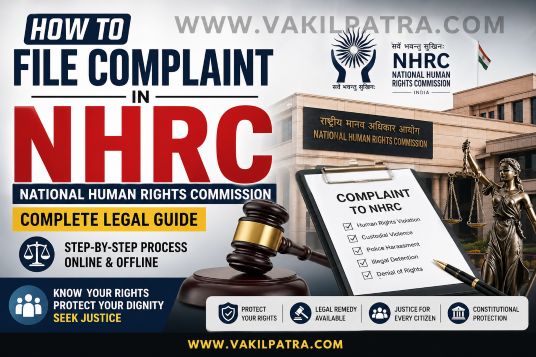
Complete legal guide explaining how to file complaint in NHRC online and offline for human rights violations in India.
How to File Complaint in NHRC Why Every Indian Should Know Their Human Rights
Most people think human rights are only for activists, lawyers, or international organizations. That is a serious misunderstanding. Human rights begin from everyday life. The right to live with dignity, the right against torture, the right to equality before law, the right to personal liberty, and protection from cruel, inhuman, or degrading treatment are not abstract legal words—they are protections available to every citizen. Whether you are a farmer in rural India, a student in a city, a laborer, a journalist, a homemaker, a worker, or a retired citizen, these rights belong to you equally. When those rights are violated by abuse of authority, state negligence, unlawful detention, police excess, institutional cruelty, discrimination, bonded labor, custodial abuse, trafficking, or denial of dignity, the law provides remedies. One of the strongest institutional remedies available is the National Human Rights Commission. Knowing how to file complaint in NHRC is therefore not legal luxury—it is civic awareness.

A common mistake people make is believing that injustice is normal and nothing can be done. Many families silently tolerate abuse because they feel powerless before government machinery or local authority structures. Fear, lack of education, and ignorance of legal rights often protect wrongdoers. Yet India’s democratic framework includes institutions specifically created to hear serious grievances involving human dignity. A National Human Rights Commission complaint can bring institutional attention to serious abuse. When people understand their citizen rights in India, they stop viewing law as distant and begin using it as protection.
Human rights are not limited to dramatic crimes. A disabled person denied humane treatment in a public institution, prisoners kept in degrading conditions, unlawful police detention, violence in custody, exploitation of vulnerable children, bonded labor, denial of dignity to elderly persons, or institutional neglect that threatens life—all may raise issues for a human rights complaint in India. In such cases, understanding how to file complaint in NHRC becomes practically important.
What Is NHRC and How Does It Protect Citizens?
The National Human Rights Commission is India’s premier statutory body for the protection of human rights. It examines serious allegations involving violation of life, liberty, equality, and dignity. Its purpose is to ensure that state power is exercised lawfully and human dignity is respected. For victims, a National Human Rights Commission complaint becomes a structured way to seek institutional review when local systems fail.
Have Something Powerful to Say?
✍️ Write for Vakilpatra — Get PublishedMany citizens ask whether NHRC acts like a court. The answer is nuanced. NHRC is not a regular trial court, but it has significant powers to inquire, seek reports, investigate, call for records, recommend compensation, suggest disciplinary action, and push governments toward corrective measures. It can examine grave incidents involving custodial deaths, fake encounters, prison abuse, trafficking, bonded labor, neglect in mental institutions, atrocities against vulnerable communities, and serious state inaction in protecting life and dignity. That makes the NHRC complaint procedure a powerful public law mechanism.
Consider a practical example. Suppose a person is detained illegally and beaten in custody. The local police refuse to register a fair complaint. Witnesses are threatened. Medical evidence exists. In such circumstances, filing a human rights violation complaint before NHRC can trigger institutional scrutiny. Another example may involve women in a shelter home facing degrading treatment. A documented NHRC online complaint may bring official inquiry. This is why people increasingly search file complaint in NHRC online as a practical remedy.
Which Cases Can Be Filed Before NHRC?
Understanding the scope of NHRC is essential. Not every grievance becomes a human rights case. But serious violations affecting dignity, liberty, bodily integrity, equality, or humane treatment may qualify. Common examples include police brutality, custodial torture, custodial death, illegal detention, forced labor, exploitation of children, trafficking, institutional abuse, prison violence, discrimination causing severe deprivation, unlawful eviction involving dignity concerns, and state negligence affecting life and safety.
A human rights complaint in India may also arise where vulnerable groups suffer systematic abuse—tribal displacement without dignity safeguards, neglect in state-run care homes, degrading prison conditions, denial of medical dignity in detention, and abuse in correctional institutions. In such cases, the legal remedy for human rights violation is not merely compensation—it is accountability and reform.
However, private civil disputes like landlord-tenant disagreements, business contracts, routine employment conflicts, or ordinary family property matters usually do not become NHRC cases unless a serious human rights dimension is involved. The core question is simple: was human dignity, liberty, equality, bodily safety, or constitutional protection seriously harmed, particularly involving state action or public authority failure? If yes, a human rights violation complaint may be maintainable.
This distinction matters because a well-framed National Human Rights Commission complaint should clearly identify the rights violation. A vague emotional narrative weakens credibility. A fact-based complaint supported by evidence strengthens the NHRC complaint procedure.
How to File Complaint in NHRC – Step-by-Step Guide
Now comes the practical question: how to file complaint in NHRC.
The easiest method today is digital filing. Citizens can file complaint in NHRC online, making access simpler than ever. A proper NHRC online complaint should clearly state: who suffered the violation, what happened, where it happened, when it happened, who was involved, and what relief is sought. Facts matter more than anger. Precision matters more than dramatic language.
If documents are available, attach them. Medical records, photographs, videos, FIR copies, representations made to authorities, witness statements, newspaper reports, and official correspondence strengthen a National Human Rights Commission complaint. Documentary support transforms allegation into evidence-backed grievance.
The complaint should be concise yet complete. Avoid writing twenty pages of emotion. Write factual chronology. Mention dates. Mention authorities approached. Mention inaction or abuse. Explain why the matter involves human dignity or constitutional rights. This improves the quality of a human rights complaint in India significantly.
Many ask whether lawyers are compulsory. No. A citizen may directly file complaint in NHRC online. A family member, NGO, concerned person, or social worker may also raise a serious issue. This accessibility makes NHRC one of the most democratic legal institutions available for rights protection.
Documents, Evidence, and Common Mistakes to Avoid
Evidence is the backbone of a strong human rights violation complaint. A genuine case with weak documentation can suffer delay. A clear complaint supported by records gains credibility quickly. Even basic documents help: hospital records, injury photographs, arrest records, CCTV footage, identity documents, witness details, copies of representations sent to officials, and press reports.
One major mistake is exaggeration. False allegations damage credibility. Another mistake is writing abusive language against authorities. NHRC is concerned with facts, legality, and rights—not emotional attacks. A clean, respectful, fact-based NHRC complaint procedure submission is more effective.
Delay is another issue. Complaints should be filed within a reasonable time. Long unexplained delay may weaken urgency unless there is fear, intimidation, illness, detention, or genuine inability to act earlier. If delay exists, explain it honestly.

People also file wrong matters before NHRC. Before submitting a National Human Rights Commission complaint, ask: does this involve dignity, liberty, bodily harm, exploitation, unlawful detention, torture, degrading treatment, discrimination, or state failure to protect rights? If yes, the legal remedy for human rights violation may lie here.
What Happens After You File a Complaint?
Once a complaint is submitted, it undergoes scrutiny. If accepted, authorities may be asked to submit reports. Records may be called. Investigations may be recommended. Findings may lead to recommendations for compensation, disciplinary action, policy reform, or institutional correction. Though NHRC is not a criminal trial court, its findings carry significant moral, legal, and public weight.
A serious NHRC online complaint can generate accountability far beyond one victim. Institutional abuse often affects many silent victims. One well-documented human rights complaint in India may expose systemic wrongdoing.
Citizens should remain realistic. Not every complaint results in dramatic headlines. Some cases move slowly. Some require follow-up. Some may be transferred or closed for legal reasons. Yet filing a lawful, evidence-based National Human Rights Commission complaint is still a meaningful assertion of rights. Silence guarantees nothing. Lawful action creates possibility.
When citizens understand citizen rights in India, they begin using constitutional mechanisms rather than suffering in helplessness. That is the true strength of democratic institutions.
Justice Begins When Citizens Stop Staying Silent
The greatest shield of injustice is public silence. Wrongdoers thrive where victims feel powerless. Awareness changes that balance. Knowing how to file complaint in NHRC gives ordinary people a lawful voice. A laborer facing forced exploitation, a woman subjected to custodial harassment, a prisoner denied humane treatment, a child abused in institutional care, a disabled citizen denied dignity, or a family suffering unlawful detention—all deserve remedy.
Human dignity is not reserved for the powerful. It belongs equally to the poor, marginalized, voiceless, and forgotten. This is the moral foundation of human rights law. A human rights violation complaint is not merely paperwork—it is a declaration that dignity matters. A legal remedy for human rights violation is not charity—it is justice.
Every Indian should understand how to file complaint in NHRC, because rights are strongest when citizens know how to use them. The Constitution promises dignity. Institutions provide channels. Law offers remedy. But justice begins only when people act.
If injustice strikes, do not assume silence is your only option. Use the law. Document the truth. Assert your rights. Seek accountability. That is how democracy becomes real.
FAQ
Can a common citizen file complaint in NHRC online?
Yes. Any genuine victim, family member, NGO, or concerned person may submit an NHRC online complaint in appropriate human rights matters.
Do I need a lawyer to file complaint in NHRC online?
No. A citizen can directly submit a factual complaint with supporting evidence.
What cases qualify as human rights complaint in India?
Custodial torture, unlawful detention, trafficking, bonded labor, prison abuse, institutional neglect, and serious dignity violations commonly qualify.
Is NHRC a legal remedy for human rights violation?
Yes. It is one of India’s most important institutional remedies for serious human rights violations.