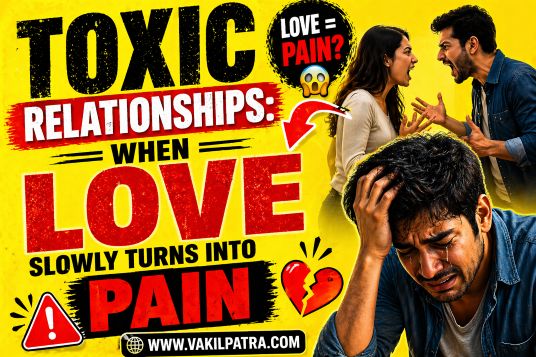
Toxic relationships can turn love into emotional pain
Toxic Relationships When Love Feels Like a Dream… But Slowly Becomes a Burden
There was a time when love meant happiness, comfort, and a sense of belonging. You meet someone, they smile at you, they care about your small things, they remember what you like — and suddenly life feels lighter. It’s like those Nagpur evenings when after a long hot day, a cool breeze touches your face and everything feels calm again. That’s how love should feel — safe, peaceful, and real. But not every love story stays that way. Some relationships don’t break suddenly; they slowly change their color, and before you even realize it, what once felt like warmth starts feeling like pressure.

In the beginning, everything looks perfect. The constant calls, the checking in, the jealousy all of it feels like care. When someone calls you ten times a day, you think, “They really love me.” When they get insecure about you talking to others, you feel special. But slowly, these same things start taking away your freedom. You begin to feel watched instead of cared for. You start thinking twice before going out, before replying late, before being yourself. That’s the moment where love quietly starts turning toxic.
A toxic relationship is not always about shouting or physical harm. Sometimes, it is much deeper and silent. It is about how you feel inside. If love is supposed to make you feel stronger, why do you feel weaker? If someone truly cares, why do you feel anxious around them? According to psychological understanding, a toxic relationship is one where one person’s behavior consistently damages the other person’s emotional and mental well-being . But the problem is, when you are inside that relationship, you don’t see it clearly.
You still hold on to the good memories. You still believe that things will get better. You still call it love. And that is what makes toxic relationships so dangerous — they don’t look toxic in the beginning. They feel like love… until they don’t.
Have Something Powerful to Say?
✍️ Write for Vakilpatra — Get PublishedHow You Start Ignoring Red Flags Without Realizing
Falling in love changes the way you see everything. Suddenly, your priorities shift. The person you love becomes your world, and slowly, everything else starts revolving around them. Your friends, your family, even your own thoughts everything takes a back seat. And in this process, you begin to ignore things that you would have never accepted earlier. This is how a toxic relationship silently builds itself, not by force, but by emotional attachment.
Imagine this your best friend tells you, “Something feels off about him.” Your family tries to warn you that something is not right. But instead of listening, you defend your partner. You say, “You don’t understand him,” or “She is just like that, but she loves me.” Deep inside, you might even know that something is wrong, but your heart refuses to accept it. Because accepting it means questioning your own choice, your own emotions.
This is where the real trap begins. You start justifying behavior that hurts you. If they shout, you say they were stressed. If they doubt you, you say they are insecure. If they control you, you call it care. Slowly, you begin to lose your ability to differentiate between love and control. Psychology explains that people often stay in toxic relationships because they feel they won’t find love elsewhere or they are not worthy of better treatment . This fear keeps you stuck even when you are unhappy.
You begin to adjust. You start changing yourself to avoid fights. You stop doing things you love because it creates problems. And without realizing it, you lose your individuality. You become a version of yourself that exists only to keep the relationship alive.
The saddest part is, you don’t even realize when this transformation happens. You just wake up one day and feel lost. And yet, you still stay because leaving feels more painful than staying. That’s how deeply toxic relationships hold you.
Signs That Feel Normal… But Are Actually Dangerous
Toxic relationships rarely announce themselves loudly. They come disguised as normal behavior, as everyday situations that seem small but slowly build into something much bigger. This is why most people don’t recognize the warning signs until they are deeply affected. What feels like care in the beginning often turns into control, and what seems like concern slowly becomes suffocation.
Think about a simple situation. You are out with your friends at a café, laughing after a long week. Your phone rings again and again. You ignore it because you want to enjoy your time. Suddenly, the calls turn into messages “Where are you?” “Why are you not picking up?” “Who are you with?” Within minutes, your partner starts calling your friends, your siblings, even your colleagues. When you finally call back, instead of asking if you are okay, they start accusing you. At that moment, something inside you feels uncomfortable, but you still try to calm them down.
This is not love. This is control.
Toxic behavior often includes constant criticism, blaming, and making you feel guilty for things that are not your fault. A toxic partner might make fun of your interests, insult your friends, or make you feel like you are not good enough. Over time, you start believing these things. You stop trusting yourself. According to psychological insights, toxic individuals often use guilt, anger, and emotional manipulation to dominate the relationship .
Another common sign is feeling unsafe emotionally. You hesitate to express your thoughts because you fear their reaction. You start hiding things, not because you are wrong, but because you want to avoid conflict. This constant fear is not normal.
A healthy relationship allows you to breathe, to be yourself, to feel respected. But in a toxic relationship, you feel drained, anxious, and constantly on edge. These signs may seem small individually, but together they create an environment where you slowly lose your peace of mind.
And the most dangerous part? You still keep telling yourself “It’s okay… this happens in every relationship.”
The Illusion That Keeps You Stuck “They Will Change”
One of the strongest reasons people stay in toxic relationships is hope. The belief that things will improve, that the person will change, that one day everything will go back to how it was in the beginning. This hope is not weak — it is human. When you love someone deeply, you don’t want to accept that they are hurting you. Instead, you hold on to the good moments and ignore the painful ones.
After every argument, there is an apology. After every harsh word, there is a soft “I didn’t mean it.” After every breakdown, there is a phase of calm. These moments make you believe that change is possible. You think, “Maybe this time it will be different.” But slowly, a pattern begins to appear. The fights repeat, the behavior returns, and the cycle continues.
This cycle is what traps people emotionally. Toxic individuals often apologize not because they truly understand their mistake, but because they don’t want to lose control. Once things settle down, the same behavior comes back. Psychology suggests that such patterns are deeply rooted in insecurity and a need to dominate, which cannot be changed easily without serious effort .
You start living between hope and reality. One day you feel loved, the next day you feel broken. This emotional rollercoaster becomes your normal. You begin to measure happiness in moments instead of consistency.
The truth is, real change is not shown in words, but in consistent behavior. If someone truly wants to change, you will see it in how they treat you every day, not just after a fight. Holding on to false hope only delays the inevitable realization that you deserve better.
When Love Starts Feeling Like Fear
There comes a point in a toxic relationship when love stops feeling like comfort and starts feeling like fear. This shift is subtle but powerful. You begin to think before speaking, not because you are careful, but because you are scared of the reaction. You start checking your phone repeatedly, worried about missed calls or messages. You begin to avoid situations that might lead to arguments, even if it means sacrificing your own happiness.
You are no longer living freely. You are constantly adjusting, constantly calculating, constantly trying to keep things from going wrong. This is not love — this is survival.
In some cases, toxic relationships become physically abusive. What makes it even more confusing is that after hurting you, the same person might show affection, apologize, and act like nothing happened. This creates emotional confusion, making it harder to leave. According to experts, toxic individuals may use anger, guilt, and even affection strategically to maintain control over their partner .
The emotional damage at this stage is deep. You feel trapped, yet attached. You know something is wrong, yet you hesitate to leave. Fear becomes a constant companion fear of conflict, fear of loneliness, fear of starting over.
But here is the truth love should never make you feel unsafe. It should never make you question your worth. The moment fear becomes a regular part of your relationship, it is no longer healthy. It is a warning sign that should not be ignored.
The Silent Damage You Don’t See Immediately
The most dangerous part of a toxic relationship is not always what happens in front of you, but what it does to you from within. The damage is slow, almost invisible at first, but deeply impactful. You don’t notice it immediately because it doesn’t happen overnight. It builds gradually, layer by layer, until one day you realize that you are not the same person anymore.
You start losing confidence. Things that once felt easy now feel difficult. You begin to doubt your decisions, your opinions, even your worth. You question yourself constantly — “Am I overreacting?” “Is it my fault?” This self-doubt is not natural; it is created by repeated emotional pressure.
You also become emotionally dependent. Even when the relationship hurts you, you feel like you cannot leave. You start believing that you need that person to feel complete. This is one of the most powerful effects of toxicity it makes you feel weak when you were once strong.
Over time, you may notice that you have distanced yourself from friends and family. Not because you wanted to, but because the relationship demanded it. You stopped sharing your problems, stopped seeking support, and slowly isolated yourself. This isolation makes it even harder to see the reality clearly.
Psychological research explains that toxic relationships often damage self-esteem and emotional stability, making individuals more vulnerable and dependent . This is why leaving becomes so difficult not because you don’t see the problem, but because you don’t feel strong enough to walk away.
The truth is, no relationship should take away your identity. Love should add to your life, not reduce it. The moment you feel like you are losing yourself, it is a sign that something is seriously wrong.
Why Walking Away Feels Harder Than Staying
Leaving a toxic relationship sounds simple when you hear it from others. People say, “Just walk away,” as if it’s an easy decision. But the reality is very different. Walking away is not just about physically leaving a person; it is about breaking emotional attachment, letting go of memories, and facing the fear of being alone.
You remember the good times. The laughter, the care, the moments when everything felt right. These memories make you question your decision. You think, “Maybe it wasn’t that bad,” or “What if things get better?” This emotional confusion keeps you stuck.
Another reason is fear. Fear of loneliness, fear of starting over, fear of not finding someone else. You may feel that you have invested too much time and emotion to just walk away. You may also worry about what others will say.
But staying in a toxic relationship has a much higher cost. It slowly drains your energy, your happiness, and your sense of self. Experts emphasize that the only effective way to deal with a toxic relationship is to set clear boundaries and be ready to leave if those boundaries are not respected .
Walking away is not a sign of failure. It is a sign of strength. It means you value yourself enough to choose peace over pain.
The Truth You Need to Accept
At the end of the day, the most important realization is this love is not supposed to hurt you constantly. It is not supposed to make you feel small, anxious, or trapped. Real love feels safe. It allows you to be yourself without fear. It respects your space, your emotions, and your individuality.
If you are in a relationship where you feel unhappy most of the time, where you constantly question yourself, where you feel more stressed than at peace it is not love. It is toxicity.
The hardest part is accepting this truth. Because once you accept it, you cannot ignore it anymore. You have to make a decision. And that decision is not easy.
But remember this you deserve better. You deserve a relationship where you are valued, respected, and loved genuinely. You deserve peace of mind.
Sometimes, the bravest thing you can do is to walk away from something that is slowly breaking you. It may hurt in the beginning, but in the long run, it will heal you.
Because real love doesn’t destroy you… it builds you.